
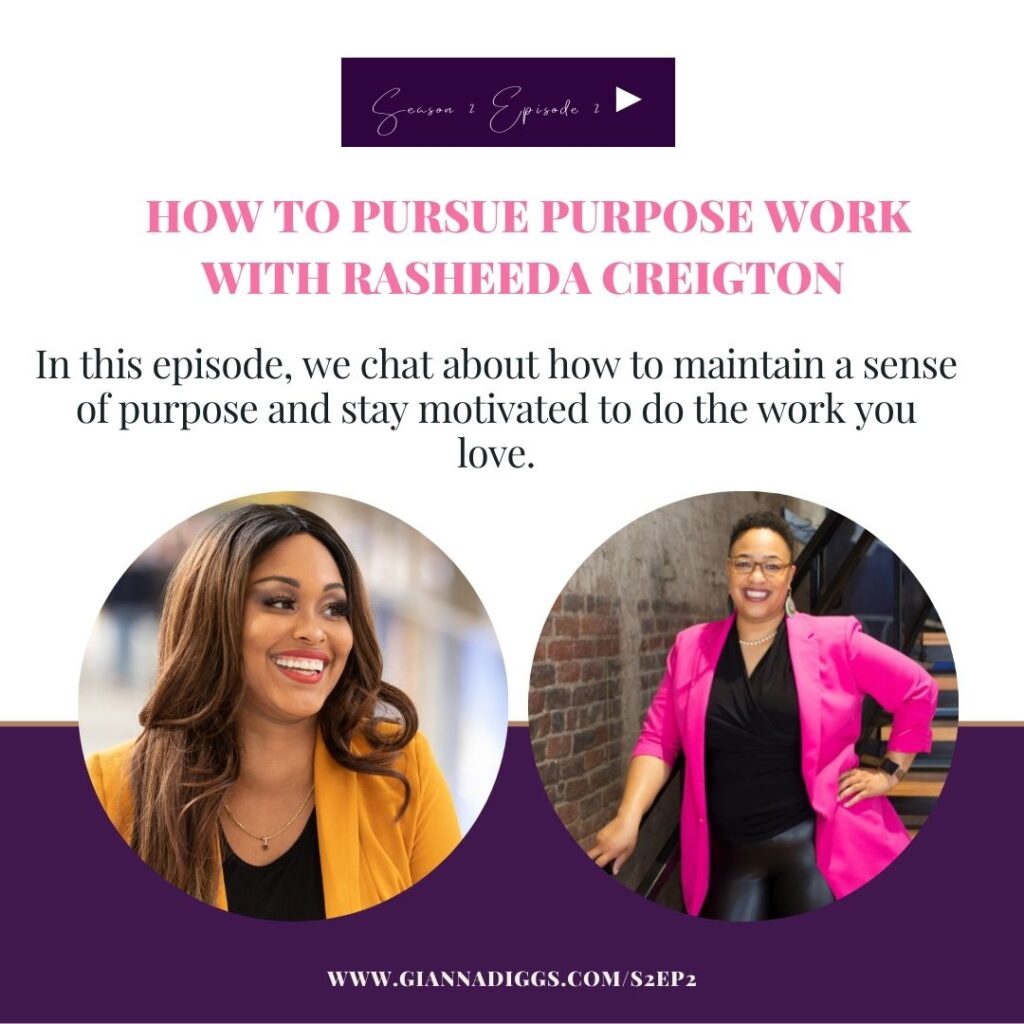
About the Episode
Have you ever felt like you’re stuck in a job or career that you don’t really love, but you keep doing it because it pays the bills? Or do you have a business but have been struggling because the work that you do lacks meaning and makes you feel unfulfilled and like you’re not using your talents to their fullest potential? If you answered yes to any of these questions, this episode is a must-listen!
This week I interviewed Rasheeda Creigton who shares her journey of leaving the corporate world to pursue purpose work. She offers advice for those looking to do the same, including how to maintain a sense of purpose and stay motivated. This episode is inspiring and full of valuable information for anyone looking to create a life with more meaning and fulfillment.
 Listen on Apple Podcast- https://www.giannadiggs.com/apple
🎙️ Listen on Spotify- https://www.giannadiggs.com/Spotify
Topics Discussed
What made Rasheeda leave the corporate world- [01:56]
The key to figuring out your purpose {6:49}
The challenges faced when leaving the security of a corporate job to fulfill purpose work {15:42}
How to maintain a sense of purpose when times get tough in your business {21:07}
How to balance staying motivated to continue purpose work while managing your family responsibilities {31:34}
Advice to those struggling to find purpose in their career/business {39:03}
About Rasheeda
Rasheeda is the founder and CEO of Killing Superwoman®, a business consulting and financial coaching company, and co-founder of The Jackson Ward Collective, a hub for current and aspiring Black business owners in Richmond, Virginia. Prior to her entrepreneurship journey, Rasheeda was the first executive director of Capital One’s 1717 Innovation Center, a first of its kind innovation center created by a corporation for the benefit of the entrepreneurial ecosystem. Rasheeda has served or is currently serving on a number of boards in the Richmond, Virginia area, though her greatest role is being mom to 3 daughters. Rasheeda is a proud Spelman College alumna and earned her Juris Doctor from the University of Michigan Law School.
Mentioned Resources
Find out more about Rasheeda’s financial coaching
Learn more about The Jackson Ward Collective
Connect with Michelle
Visit Rasheeda’s website
Follow Rasheeda on Instagram- @rncreighton
Follow Rasheeda on Twitter- @rncreighton
Connect with Rasheeda on LinkedIn-@rncreighton
Connect with Gianna
Follow Gianna on Instagram- @giannadiggs_
Follow the show’s Instagram- @themompreneurmindsetpodcast
Follow Gianna’s Facebook Page: Gianna Diggs
Transcription
*Transcript is unedited (for the most part)
Gianna Diggs 0:05
You are listening to the mompreneur mindset podcast, a space where we empower you to build an aligned business. So you can spend less time on the things you think you should be doing in your business, and more time with the people you love. I am your host, Gianna Diggs. Let’s get into it
Welcome back to the show. So in today’s episode, we’re going to talk about purpose work with my guests Rashida Creighton. So a little bit about Rasheeda. She is the founder and CEO of killing Superwoman, a business consulting and financial coaching company and co founder of the Jackson Ward collective, a hub for current and aspiring black business owners in Richmond, Virginia. Prior to her entrepreneurship journey, Rasheeda was the first executive director of capital 117 17 Innovation Center, a first of its kind Innovation Center Created by a corporation for the benefit of the entrepreneurial ecosystem. Rashida has served or is currently serving on a number of boards in the Richmond, Virginia area, though her greatest role is being a mom of three daughters. And Rashida is a proud Spelman College alumna, and she earned her JD from university from the University of Michigan Law School. So without further ado, let’s get into the interview.
Hey Rasheeda, welcome to the show.
Rasheeda Creighton 1:31
Hey, thanks for having me.
Gianna Diggs 1:32
So I’m excited because today, we’re going to be talking about one of my favorite topics, something that I am really big on, I’m a huge advocate for and that is purpose work and finding what your what you love to do, right? So as stated in the in, in the intro, right, you come from corporate world. So tell me or talk to us about like, what made you leave.
Rasheeda Creighton 2:00
So it’s actually kind of a funny story I, I had been, I worked for a fortune 100 company, I had been there for 15 years. And the last role that I had, when I took it on, I knew it was for the purpose of building something. And then I would move on to the next thing, which is actually kind of how I operate. Like, I prefer to build things. And so we were a year and a half. And I knew that like in that next year and a half, it would be time to go into the next thing. And so I had started conversations with my manager at the time to say, Okay, let’s figure out what’s next where you want to go. What was made clear to me was like urine asset we don’t want you to leave accompany, and your next role should be a promotion level role. So like all the things that you want, if you’re climbing the corporate ladder, and they would send me job postings, they would write up job descriptions for me. And I was trying to figure out what I would do next. And I take the last two weeks of the year off always as kind of a reset. And so during that time, I was kind of doing some deep digging, little thought provoking, you know, sometimes we get a little extra deep, but like trying to figure out what is it that I wanted to do next, and it just kind of came to me like very clearly it was like, it’s time to leave. And at that point, it was, I was at the end of my life. I was I just started my 14th year at the company. And so I well back to work in January, I’m sitting down with my manager, we are reviewing my year end performance thing, right? So you sit down, you go through your year in review, you get your money, how much money you’re gonna get all that stuff. And we went through everything. And I was like, okay, these questions we answer those questions is like, Okay, go, she’s like, let’s talk about this year and what we’re going to do. And I looked at her, and I said, I think my time here is up. And I would like to get to my 50th anniversary, which would be in that September. So this is January of 2019. And, and I said, I That’s my request, can I get to September and after that, like I’d like to wrap up. And I had the option to negotiate a few things, I was able to actually get my position eliminated, which qualified me for some other things that made it easy to transition. But I remember saying, so what are you gonna do? And I was like, I don’t know. I just know that my season is up. And I really believe in seasonality for anything in life. And so like the moment I was like, I think my season here is up and it’s time for me to leave. It was like a weight lifted off my shoulders because I had been stressing about What was going to be next? And the stuff they were presenting to me was really good. But I didn’t want to do it. And like, I kept looking at it being like, I don’t want it, I wonder. And so the moment I was like, I’m good, I’m done. And it took them a while, because it was like, What are you being pushed out? I, what are you gonna do? And I’m like, I don’t know, I just know, I’m not supposed to be here anymore. And I’m okay with that. And my last day of work, like, you talked about purpose and intent, but then you talk about for me, it’s like, God knew what I didn’t know. My last day of work was March 9 2020. I am a single mom, my child was in kindergarten, her school shut down, just like everybody else on March 12 2020. There is no way I could have continued working there and done what I needed to do to be there for her at that point. But a year before I had no clue, I just knew I’m not supposed to still be here.
Gianna Diggs 6:08
Right. Right. That’s interesting. Because, you know, it speaks to us kind of stepping out on faith, because and that’s regardless of you know, how, however you look at God, the universe, the divine, you know, how have you view it? And because you were just like, I don’t know, but you just knew, right? Like, it was time to go, can you rather than ignoring it, and then scrambling? Come March 12? You listen to it, and it actually kind of saved you?
Rasheeda Creighton 6:42
Yeah, yeah. made a huge difference.
Gianna Diggs 6:46
Wow, that’s, that’s powerful. So in moving from the corporate world, to creating not one but two businesses, where you do where you can do purpose work? What was the key to figuring out like, your purpose, were there any, like specific things that you did? That kind of helped you go like, yes, this this is my purpose.
Rasheeda Creighton 7:08
Yes. So it’s actually kind of funny. One business that I co founded with two other people came out of my my last role at my at the corporate job, because I was really doing work in the community on behalf of the organization focused on small businesses and entrepreneurship. And so I was I had a lens of I was running a building that was for entrepreneurs. And so I had a lens that allowed me to see what was going on in the ecosystem. But also to see that while there were a ton of opportunities that were not opportunities, there were not black entrepreneurs in that space. And so we weren’t represented there. One of my co founders, runs her own coffee shop, only black woman owned coffee shop in Richmond. And she came at a same conclusion about why aren’t we connected from her own experience and trying to launch and so we kind of, I had that piece that sort of came together, just naturally out of experiences. And then my third co founder has been doing business coaching for entrepreneurs for 20 years. So she also knew like, the folks that are out here coaching black entrepreneurs don’t look like black entrepreneur was very, you know, white savior ish, instead of being an authentic experience. And so we came together to form Jackson wart collective, really to solve a problem that we saw, but we saw from different angles. And that started before I left my corporate job, like we started talking just in passing, like, hey, we need this. And it was like, Yeah, we do. And then we started talking in more detail later. So that one, I don’t say stumbled upon it. But I firmly believe that everything I’ve ever done has built upon itself. But I didn’t know it at the time. Like I wasn’t taking the thing going, Okay, this is the next step to get me over here. It was just I think this is the right next step. And then and when I look back, it’s like, all of these things brought me to this point. So that one kind of came naturally out of experience. My other work on the consulting side has come a bit out of personal experience and passion. But it’s something that because I focus a lot on financial freedom in that space and understanding money. It’s something that I talked to a friend of mine recently about around
there is a cost to not having money, right? There’s a time cost. There’s a Rhythm costs, there is a cost to having money stress. And a big part of that cost is the thing that we don’t always think about, which is how much brainpower it takes like when I was deep in debt, and living paycheck to paycheck. And and I’m gonna pause here to say like so often, people think paycheck to paycheck is about like people that have low paying jobs. But there’s a whole lot of people living paycheck to paycheck to take home, six figures, or more. And so it’s really just about like, how do you manage those funds? And related to that, when you have money stress that weighs on you, that’s what you’re constantly thinking about cannot cover this kind of pay for this. How are we going to make this happen? Oh, this is about to come, don’t want to answer the phone, don’t want to open the mail, right. But that takes up brain power. And so what I found was, once I stopped burying my head in the sand and be like, I don’t want to look at that, and started looking at the money and then took control of it in a way that it wasn’t about having access, it was just about giving me peace, that I knew that everything was taken care of like all our bases are taken care of, I could breathe. But when I couldn’t breathe, it also took away that thought those thoughts that took up brain space around that. And I say all of that to say, for me, a lot of the work that I’m doing has come out of having free brain space to actually be creative. So when you’ve removed a stressor, and you remove the need to focus your thoughts on that you actually free up space that you can dream more. And you can think about what what if, and for me, it’s it’s a little bit of dreaming, but it’s I’m not the one that’s like, sits around and sort of daydreams in that way, right. I’m the one that I’ll be driving and a photo flap in my head. But I’ve got space, so it can kind of land and sit and I can sit with it for a little bit and like ponder on it, or I’ll take walks or if I have a long drive. I listen to a podcast, and nine times out of 10. I am listening to the podcast, but my brain is going so fast that it’s like triggers all these other spots. I didn’t have that space for that when I had so much money stress. And so it kind of naturally has evolved of creating a space for me to be able to just be and I recently shared this somewhere else I was talking about. So often we say if you say yes to something, you’re saying no to something else, right? And vice versa. But sometimes we need to say no, just so that we have room for the opportunity say yes, when it comes it doesn’t have to be a zero sum game of no means yet no here means Yes, over here. It could be no here means no, there’s still room. And the really cool thing that you want to say yes to comes through, maybe immediately, but maybe later. But I have space to be able to do it. It’s the same thing with the thought piece.
Gianna Diggs 13:26
Right? And I think that’s why I focus a lot on mindset work, right? Because in doing the journaling, meditation, or even just a tapping session, or any any type of mindset work. What I’ve realized is that, that helps me get creative when I’m stressing about a lot of stuff, right? Like, currently at this moment, you know, I’m pregnant. I’m also planning a baby shower. Also, we’re getting married the day before the baby shower, and I have all these different things going on. And I feel like without that mindset work, it’s stressful. I’ve had many stressful days, right? But I create space for myself to be creative to be able to send my guests great questions to be able to think of how my business is going to evolve because I give myself that time. Yeah, and that energy to just be for a second. And I think that so that you saying that is so powerful, because a lot of times with the things that’s going on in his world, we we consume so much that’s going on, that it causes those stresses. And we don’t have time to just go into our bubble and allow for it and decompress. Yeah, and let ourselves have space to say okay, I did this work. I you know, I journaled out all the stresses that I’m feeling and now the weight is gone. And now I can get creative about I’d like to talk about finances, how I can maybe decrease my expenses so that I’m not living, you know, paycheck to paycheck, for example. And so I’m glad you said that because, you know, there’s a lot going on in this world right now we know, you turn on the news every day you see something crazy, right? Well, we have to give ourselves that, that space to just be creative and find ways that don’t take that much work. You know, journaling is not your thing, like you said, going for a walk, right? Just to free up that brain space to be able to be creative. I’m so glad you said that. So we know that the decision that you made, a lot of people would not make to leave a great pain, corporate security. Yeah, right. To do purpose work, right. It’s not the easiest decision that someone can make. So what were some some challenges that you faced,
Rasheeda Creighton 16:02
um, you know, a lot of it came in my own head. So you know, let’s go back to the timeline. I told my boss in January of 2019, right, I want to make this transition. It took three months for her to get sign off for it to happen, because people are like, but we don’t want black woman fairly senior in a corporate environment. Let’s be honest, like, we can’t really, we can’t really let you leave forever. be pushing you out. What’s happening is like, No, I’m good. We good. We all good times. So that took a while. And then we created a plan. Because what I had been doing all along, which was always the plan, right was building a team that could run what I was running without. That’s exactly what I was always building. And so at this point, we’re at, like, maybe your 2019. And they are there. They don’t know that they’re there. But I know they’re there. I can see it. And so I start to slowly pull myself out of stuff and hand more responsibility over to them because I’m preparing. And in October, I told my team, I was like, Okay, I need y’all to know, this is what’s going on. I’m still here for the next few months. So I have moved, like I have moved all the files in the in our shared drives so that they can have access to them. And I was like, I’m not gonna talk in meetings, you drive it, if you need anything. If there’s stuff I forgot to document for you like this, you got three months of like, I am at your full disposal. And after I had the conversation, I had a moment and I was like, oh my god, what am I doing? I got a kid, it’s just us. At that point, we had met her dad and I had made the decision that being in public school was not the right place for her. And so I’m in the process of moving her to private school. But I’m about to foot that Bill myself. And I was like, Who? Who will pay tuition? Like all the things popping in my head and out? Yeah, you do stuff. And you, boy, when did I just do? That was what I went through. And so I had kind of been on pause with my therapist. And I was like, we’re gonna need to pick back up. I did a thing. And I know it was the right thing. But right now I’m kind of freaking out. And so I went, we went back into like, deeper therapy to work through what I was feeling, which is normal, right? Like, you make a big choice. And then it’s happening. And you’re like, maybe I shouldn’t have done that. I probably shouldn’t. But maybe I should. And I actually spent most of my time there. Like, I was nervous, I was shook. I was just like, I don’t even know what I’m gonna be doing when I’m just not gonna be working here anymore. Financially, we were in a really good place. As part of my divorce, we were able to pay off most of the debt. And it was wrapping up at the same time. And so like, I didn’t, I still had student loans. I still had my townhouse at the time. So like, I had little things but nothing major. So I knew like honey, actually we will be okay. I kind of built up a plan through the year to make sure that was good. So I knew worst case scenario, we could get through 2020 Fine with no lifestyle adjustment. And so I was like, okay, that part’s Okay. Let’s set that to the side. The rest of it in terms of what I’m gonna do every day. I don’t I don’t need didn’t know. So that was hard. That was hard. It was it was all in my head. It was all in my head.
Gianna Diggs 20:09
Well, yeah, that’s I feel like, that’s probably, I’m not gonna speak for everybody else. But I know at least that’s like the number one thing that, you know, I see is it’s just your, your mindset and like, we start to worry, it’s like our fear our our conscious fears start to your subconscious fears come out. Yeah, right. And we start to, you know, our conscious mind lacked latches on to it, because it’s like, oh, wait, did I just What did I just do? It’s like, oh, I don’t know if I should be doing that. Um, so yeah, I definitely see that like, mindset is definitely something I can’t say is everyone, but 95% of the time, that’s usually what we don’t want to do
Rasheeda Creighton 20:57
is, you gotta get out your own heading out your own way.
Gianna Diggs 21:01
Right. So, how, how have you like I said, with their multiple businesses, businesses, right? How do you maintain a sense of purpose? Like, when things kind of get tough? Because it’s like, stuff is gonna never everything’s never gonna be like that again. Great, right. So like, how do you hold on to your, your sense of purpose, and the idea that you’re doing purpose work? When times get hard?
Rasheeda Creighton 21:29
Yeah. So one of the things that I did starting out, which I think has created a really solid foundation for me, so my older brother does executive coaching. And when I was leaving, he was like, I can’t coach you. But I’m gonna give you this advice that I would give any of my clients. And what he told me was take a week off for every year that I was at the company. And he was like, if you can do it financially, do the whole time, if not do as much as you can. And I was able to do that. I went into redeployment at the company in January. And so I started that process in January, which I’m glad I did. Because COVID until the intent was to take 15 weeks, and I did nothing I didn’t like and when I say I did nothing, I mean, my daughter was still in public school. So she took the bus in the mornings. And I picked her up in the afternoon. And it was really important to me that I do those things. And so I walked her to the bus stop every morning, I picked her up from school every afternoon. Other than that, I had no plans and no schedule, it’s really easy to start scheduling yourself for all the things right, oh, let me have coffee with this person. Let me have lunch with this person. Let me do this. Let me go here. And I made a point to not do it. And so I stopped, I stopped using an alarm clock. It’s actually been three years now since I’ve used an alarm clock. And I would just sort of wake up when I wake up. I didn’t fill my day. And I just kind of went with how my day felt some days, I will get really creative. You see I got a whiteboard over here. That thing is actually huge. That’s like the very last corner of it. But like out some days, I get creative, and I start whiteboarding, all kinds of things as these ideas are pouring out of my head. Other days, I’m like, What can I catch up on on Netflix? And that’s what I do. Because, and I still say I’m still in this process of undoing, I had to kind of undo the corporate habits that I had, I had to learn that it’s okay to not sit in front of your computer, have it like you don’t have to, you can move around and do the things. And I say that as a foundation for how I stay really grounded, is actually revisiting that. So with the business I have with my co founders, we close once a quarter for a week, this is actually the week that we’re that that business is closed, and it is to do the reset. But the other thing that we make a point of doing is we’ve always and I do it with both. It’s like what is important, like why do we do this work? And what are we trying to achieve in doing this work? And I’ve created it as a framework. So that because people will have suggestions and ideas of what you should be doing, right? Oh, you do this, you should also do this. You should talk to this person. They do this. Y’all should partner. And I’m always cool to have a conversation. But that doesn’t mean that it will result in anything. And I’m okay with that. Because sometimes I’ll have a conversation and then I’ll revisit in my head but this is my framework. This is what’s important. This is why I’m doing this work and this is the type of impact that I want to make. Does this align to that? No. Why we haven’t we’re not. Thank you was great to me. You are like our need to keep doing stuff. And, and that combined with the fact that I work with people, and people communicate back, right? This is the impact that you have made. That’s the thing that keeps me going. Because you can see even in little tangible ways, and I think sometimes we look for the big splash stuff. And we forget about the friend that, you know, I did. I was telling you earlier, I spent just finished this budget coaching certification course. And I had to have people that I coached as part of it. So I did it for free. And one of my friends, she was like, Oh, my gosh, I was out and I bought something. And I was like, Oh, you didn’t budget for this. And then I needed to move money around. And like, that sounds super nerdy. But that stuff makes me happy.
I was like, Oh my gosh, you’re gifted, like, I’m so proud of you. That’s a win. It’s little. And it’s a moment, but it’s a moment, that’s gonna keep me going. And so when I stay within where I am, and what I care about, and then I have those moments. That’s what keeps me going. Because some that last night, let me tell you, I was so tired last night, like people, like you good. Like, you don’t even sound like yourself. Like I’m exhausted, like the past couple days have just been exhausting. But I got up this morning. And I’m like, let’s roll. Because because I love what I do at the end of the day.
Gianna Diggs 26:37
Right? I love that you talked about, you know, the what your brother said, taking off time. Because, you know, with me working with human design, he’s now my clients like that, that process is the deconditioning process, right? Because we are taught to operate in a way that is like on the go all the time. And then we wonder why we burn out. And it’s because you don’t give yourself that time to just decompress. Like, you know, I’m not a coach who talked about Netflix, who was just like, Don’t spend your time watching Netflix and this and that. Now, of course there is excessive, right? Like, you could be doing something more constructive when you sit and binge Netflix all day. Like there there are those moments of like, okay, balance, right. Yeah, but, but it had, but just giving yourself that time to catch up on your show. Like, there’s nothing wrong with that. And I think that reason why people think there’s something wrong with it is because of that. Be on the go all the time, corporate, you know, I got to work 10 hours a day, I got to be on my laptop all day. So I’m glad you were able to like decondition yourself, because it actually, like helped you set up your business in a way where it doesn’t burn you out, right? Because what’s the point of going from corporate to entrepreneurship, if you’re gonna burn out anyway.
Rasheeda Creighton 27:55
And people say that you see, as they say, on social media all the time, like how work more than I did when I worked for somebody else? And I’m like both, but why?
Gianna Diggs 28:05
Why why, right. You’re doing it all wrong.
Rasheeda Creighton 28:12
Let me tell you something I don’t take I don’t take meetings on Mondays. Me neither. I don’t take meetings before 10am. Now, I know you’re not a morning person. But my reason for not taking meetings earlier is I am a morning person. That is my best thinking time. So I don’t want people to come in during my best thinking time, like, I need to get stuff done. And also, as you grow in your career, and when I say growing career, I actually never mean age, I just mean expertise. But as people grow in their careers, what took you 810 hours upfront, takes you to three hours now maybe, right? And so what I can get done from the time I dropped my daughter off until my first meeting at 1010 30. That might be what was a whole day back in the day. And so like for me, it’s like I get that sometimes I had somebody asked me to meet on a Friday at four I said, Oh, I don’t do meetings after two o’clock on Fridays. I have I have set boundaries. And I honor them. And like even when because that tells you about other businesses all break this week. And I’m struggling because I’ve been checking email because I was looking for something. And there’s an email that has come in that I want to respond to so badly like I was so excited about the email, but I’m like, we’re off. We’re closed. I can’t and I have an out of office on that says we will not respond to you before next Monday. And so like I am going to honor that pucker when I tell you is killing me I want to respond but that’s that Is us also honoring our own boundaries? Because so often we leave room to violate them. And once you one person do it, or you do it yourself, you descend this cycle and that grind, grind culture needs to die.
Gianna Diggs 30:16
Right? No, I agree. Like, it’s hard for me because I want to, I want to be that person that comments every time I was just like, and they worked hard, and they hustle. And you got to do this. And it’s just like, I don’t, I don’t want to do any of that. Like, I don’t, I don’t want to hustle. I don’t, I don’t want to work hard. I want to I want to be, I want to work smarter, not harder. Like, I don’t want to do that and that. But because we look at people where they’re like, oh, they worked hard to get where they are. So I have to do the same. And like, you sacrifice yourself care, you sacrifice your health and your family time. And you do all these different things. Just because you’re trying to work hard. And then you look at what you did. And you’re like, but I got nothing done. It’s like so are you like, like when you need to you if you did create balance in your life, you probably actually would get more done. If
Rasheeda Creighton 31:03
you get so much done when you’ve like, it’s almost like compartmentalizing. But like if you just block things, you get so much more done in being like, not sure where to start. But we just got to sit here like not
Gianna Diggs 31:17
right. And that’s funny that that we kind of are talking about balance, because that actually leads me into my next question. Because again, you are balancing two businesses, right. But you also have to balance you’re taking care of your family, your home life, right. So how do you stay motivated, right to continue your purpose work, while also knowing that you have buy gear at home responsibilities?
Rasheeda Creighton 31:42
Yeah. My kids are a big motivator. So I always tell me, I have three daughters. The older two are not my biological children. They’re my ex husbands kids that I helped raise. So they’re, they’re my daughters too. And they are 2417 and seven are the three girls. The seven year old is a woman’s home with me. But and I tell them this, but you know, like when your mom tells you something, it’s like, okay, that’s nice. But they motivate me. Really, right? Like, the fact that the seven year old does not say you’re always working anymore. Right? Right. Damn, Matt, that means a lie. Like mom guilt is a thing. And in that means a lie. And, you know, every now and again, if I have, because I sit on a number of boards, and so a couple of them meet in the evenings. And so there’ll be a week that she’ll be like, always in a meeting, because I might have like, three board meetings that week. But for the most part, she knows I dropped her to school, she gets out of school, mid afternoon, I pick her up at school, we hang out, I take her to her activities. And that’s really, really important to me, it’s important to me to be the one that is there. And most of the time I can kind of watch while she’s at gymnastics, like I can watch her and see what’s going on. Sometimes I’ll have my laptop, and I gotta roll. And that’s just kind of how things are. But I try to find that space. And folks, folks know. If you need to talk to me in the evening, you need to talk to me after 8pm Because that’s her time. And that’s really, really important. Or, you know, my oldest just finished her Master’s. And yeah, I was people are like, Well, what you got going on? We’re doing it and I was like, my oldest is graduating like that is the middle one is graduating this coming weekend, right? Like, no, this is this is family time, this is what we do. And that is that is actually a more of a motivator in the balance for me. Because I like having my own businesses because it allows me to be present for those things for them. And it allows me to be present with them in ways that I could not figure out how to balance before. And now I control that. And so like people that book on my calendar, we don’t see anything available after 230 during the week, because that’s the time that I start shifting into, we don’t pick up we got activities, we might just hang out, you know, or we can just decide, oh, on the way home, I started playing around. And I like that that’s fine. That’s important to us. And so I prioritize the family piece over the workpiece and I actually allow the businesses to fit into that. And with the one that’s not just me with my business partners, we actually build that into our culture. So two of us are single moms, you know, kids at different stages. You know, all of us very busy. and community involved, and we prioritize those things. We’re not the people that had the kids, you know, camera. And that’s not like when we were together, it’s like, Hey, sweetheart, how you doing? And like we had a meeting Sunday over breakfast. Because we do that periodically just catch up over breakfast and I’m on my way to the restaurant. I was like, Hey, are you bringing your daughter? Like, how many seats for the sole purpose of how many seats do we need? Right? Right? No other reason than that. And, and that, that is something that is special to us. Like, we can build this and be fully authentically ourselves at all times.
Gianna Diggs 35:45
Right? I’m gonna do I’m glad you said that. Because, you know, my daughter will interrupt me, and initially used to bug me right in the beginning stages, right? Like, I’m speaking from the beginning stages of it. And you know, a lot of times we do try to shoo our kids out, and I’m like, you see me doing something, you’re interrupting my recording, you’re interrupting this year that and I just learned to just let her okay, you, I’m in a meeting. All right, you want to come say hi. And she’ll come say hi. And then she’ll go about her business. Right? And, and I had to learn that because I used to just get upset, like, oh, you I told you I was doing this and you want to come ask me a question. You could actually daddy because he’s downstairs. But you know, it’s like, why don’t you ask your dad but she’s like, Can I do this? And I’m just like, Okay, now I’m just like, alright, she’s coming in to help me. Okay. You need that. All right. Okay. Are you done? You want to sit with me? Are you are you don’t? Okay. You don’t aren’t by great. But I think that that’s a that’s a it was a learning curve. So I’m glad that you said that for for the moms out there who are new to business who are are navigating their children interrupting them? Because it definitely does happen.
Rasheeda Creighton 36:54
And it can be distracting, right? Like, yeah, it was I was I was doing a training for a client. Like I was facilitating a training. It was like 80 people in the training on the webinar. daughter comes in, she’s at a school that is she was mad. She’s obsessed with rain. It she was mad because it wasn’t raining. And so she comes in, and she’s yelling, she’s crying and to the right. And like, in my head, I’m cracking up laughing. But I’m also like, this is the worst possible time. And I was like, Yeah, I could just excuse me for one moment. I go off, you go on mute, go off camera, go deal with it. But I can’t make it rain outside. I’m really sorry. But my God, but you can go play outside and you can still wear your race. But like, it doesn’t take away and awareness of that doesn’t take away the physical reaction of like, you get all hot and flush. And you get all like you got to be kidding barest it bears. That doesn’t go away. You just sort of learned like, she talked in a meeting yesterday, I let her have a mental health day yesterday. And folks were like, I was on mute. And I was like, let her come off mute and say hi. And I’m like, Okay, you good. Thank you busy.
Gianna Diggs 38:26
Yeah, I mean, these kids, they’re gonna do what they need to do, you know. And if they need to say something she wanted to play in rain, that’s what it was. But I love that you say having the awareness of like, it’s okay. Because, you know, not everyone is a parent, but a lot of people are dealing with the interruptions, because the pandemic has created a more virtual world. So, you know, like people like, Oh, I’m sorry, my child, I’m like, that’s fine. My kid interrupts all the time. Right? You are okay. Yeah. So, I want to talk to the mompreneurs out there who feels like they’re struggling to really find that purpose work. So, you know, like, maybe they started their business as a way to just make some extra money, right, but they don’t feel fulfilled in their purpose in what they’re doing. So what advice would you give them?
Rasheeda Creighton 39:22
I would say don’t force it, and let it come naturally. And I say that because I think there is this this thing that is permeating our culture of like, you know, make money grind side hustle. And I think some people start a business because it’s like, well, that’s probably what I should do. And then others start a business because it’s like, I really love this and this is what I want to do. And there’s some there’s some in the middle sometimes it’s it’s just a necessity. But I would say if if it feels core to you, if you feel it in your heart like that gut ins I think everything in life to me is largely gut instinct. Go with it and keep pushing and expand your network and reach out to other folks who may have been there already, or could be in the trenches at the same time. And just have those conversations, because I guarantee that you’re not the only one that feels that way that several other people feel that way as well. So I would definitely do that. But then also be really honest with yourself, because sometimes, especially if you’re doing something on the side, everything costs count the cost. And I don’t just mean the monetary costs, right? If this is causing you stress, if this is taking away from the things that you really care about doing. Do you want to keep doing it? Maybe it’s a pause, maybe it’s not right now. Or maybe I thought this was for me, but it’s not. And guess what all of those things are, okay, we have to give ourselves permission to change our minds. And there is nothing wrong with that. And that goes for like, if I changed my mind and want to pivot my business because I found this other path, do it. Right, make a plan and do it. If you change your mind and say I want to be in business. That’s cool to like, do that. But Be true to yourself, and be true to where your heart is leading you.
Gianna Diggs 41:22
Right, that’s powerful. Thank you for that. So before we wrap up, can you tell people where they can find you online?
Rasheeda Creighton 41:29
Absolutely. So I am on Instagram, Twitter and LinkedIn at RnCreighton. That’s our n c r e i g h t o n. And then my website is Rashida creighton.com. So that’s Rasheeda with two e’s are a sh, E D, A, C r e i g h t o n.com. You can find my coaching stuff there. Any information about stuff I’m doing or anything, any recent news or that kind of stuff is all there so you can find me on all of those places.
Gianna Diggs 42:05
All right, we’ll see you there. Thank you so much for being on the show today. This interview was really interesting. I love purpose work. So it’s like one of my favorite topics.
Rasheeda Creighton 42:13
Well, thank you for having me. It was a pleasure catching up again, too.
Gianna Diggs 42:23
Thank you for listening to the mompreneur mindset podcast. I hope you found today’s episode valuable. If you enjoyed listening to today’s episode, I would love it if you could subscribe rate or review the show your support, it really means the world to me. Also, if you want to join in on a discussion about today’s topic, and seek guidance, assistance and advice from fellow mompreneurs I invite you to join the mompreneur mindset community. You’ll find a warm and supportive group of women who are eager to help you achieve your business goals. So head to www dot Gianna diggs.com backslash community for more information
Transcribed by https://otter.ai