
About the Episode
The importance of language learning cannot be understated. In today’s increasingly globalized world, the ability to communicate with people from different countries is a valuable skill. For businesses, being able to reach a wider audience can mean the difference between success and failure. For families, being able to communicate with loved ones who speak another language can help to keep everyone connected. The benefits of language learning are clear. But how can you go about incorporating it into your life?
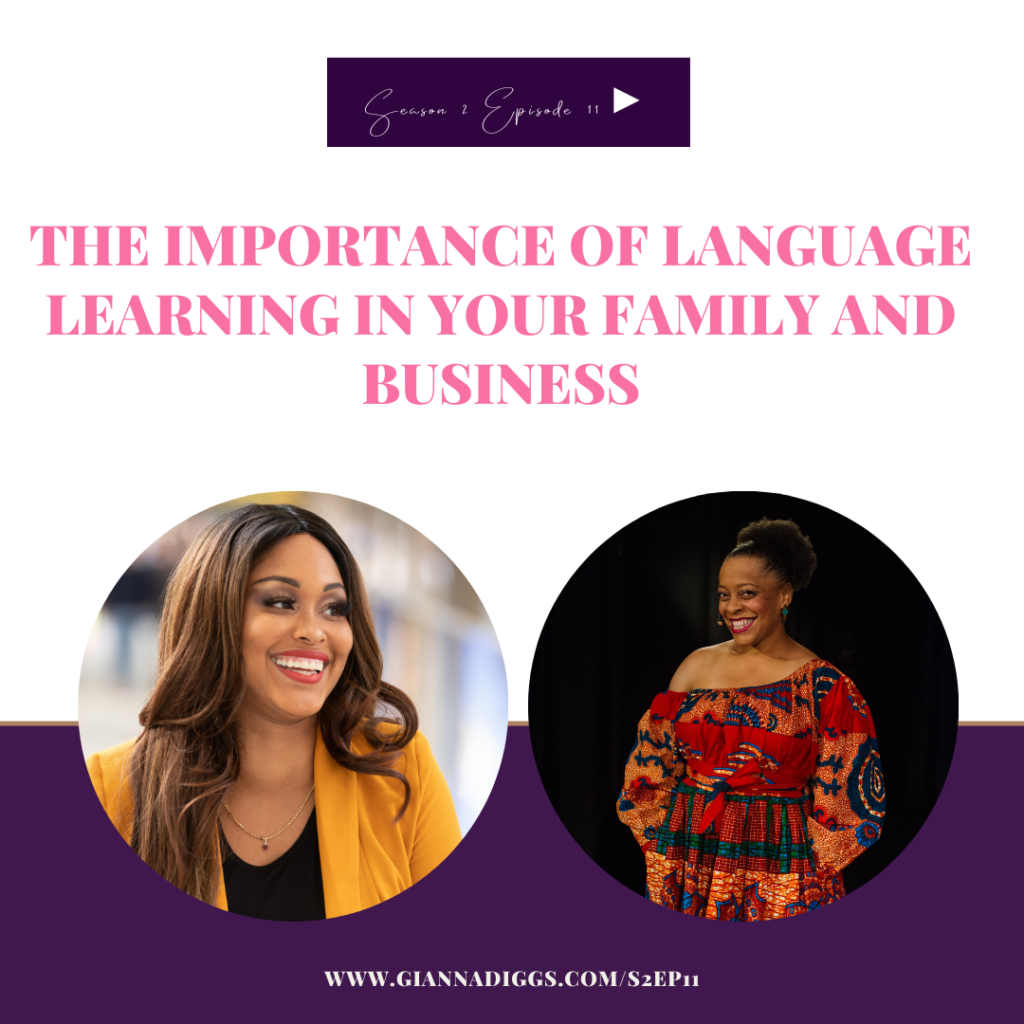
In this week’s episode, you’ll learn from Dr. Kami Anderson about the importance of language learning in your family and business. Dr. Anderson is a bilingual Black woman who knows just how important it is to be multilingual in today’s world. In this episode, Dr. Kami Anderson discusses the importance of language learning in your family and business. She shares how her business, Bilingual Brown babies, came about, the importance of black people being bilingual, and strategies to use to make sure language learning is a priority for your family. She also discusses the benefits of being a bilingual mom entrepreneur and provides suggestions on how to make the process of learning a new language less daunting.
This episode is perfect for moms who want to learn more about the importance of language learning in their family and business.
 Listen on Apple Podcast- https://www.giannadiggs.com/apple
🎙️ Listen on Spotify- https://www.giannadiggs.com/Spotify
Topics Discussed
How the idea of Bilingual Brown Babies came about {02:44}
The Importance of Black people being bilingual {06:58}
The strategies to use to make sure language learning is a priority for your family {12:00}
How learning another language helped her in her entrepreneurship journey {15:35}
Some of the benefits of being a bilingual mom entrepreneur {17:20}
Suggestions on how to make the process of learning a new language less daunting {21:44}
About Dr. Kami
Dr. Kami is an interculturalist, scholar and language advocate. Originally from Milwaukee, Wisconsin, She has always kept a tight grip on her passion and compassion for others and difference through language. Her primary focus is family empowerment through language with an emphasis on application and confidence. She holds a Bachelor’s degree in Spanish from Spelman College, a Master’s degree in International Affairs/Interdisciplinary Studies in International Communication and Anthropology from American University and a PhD in Communication and Culture from Howard University.
Dr. Kami Anderson is the founder and CEO of Bilingual Brown Babies and creator of a revolutionary online program that meets Black families where they are in their journey to bilingualism. She’s a passionate lifelong teacher and the go-to girl when it comes to language, Blackness, and identity.
Dr. Anderson has written several of her own books including Raising Bilingual Brown Babies: Everyday strategies to become a confident bilingual family (2018, KDP Publishing) and Language, Identity and Choice: Raising Bilingual Children in a Global Society (2015, Lexington Books) which talks about her own experiences raising her children bilingual. She has another book, tentatively titled The Color of Language, set for publication with Peter Lang Publishers, Fall 2022.
Mentioned Resources
Connect with Dr. Kami
Follow Dr. Kami on Instagram- @bilingualbrownbabies
Follow Dr. Kami on Facebook- @bilingualbrownbabies
Connect with Gianna
Follow Gianna on Instagram- @giannadiggs_
Follow the show’s Instagram- @themompreneurmindsetpodcast
Follow Gianna’s Facebook Page: Gianna Diggs
Transcription
*Transcript is unedited (for the most part)
Gianna Diggs 0:05
You are listening to the mompreneur mindset podcast, a space where we empower you to build an aligned business. So you can spend less time on the things you think you should be doing in your business, and more time with the people you love. I am your host, Gianna Diggs. Let’s get into it
Welcome back to the show. In today’s episode, we’re going to talk about being black and bilingualism with my guest, Dr. Cami Anderson. And a little bit about Dr. Kami. She is an inter inter culturalist scholar and language advocate. Originally from Milwaukee, Wisconsin, she has always kept a tight grip on her passion and compassion for others, and difference and difference through language. Her primary focus is family empowerment through language, with an emphasis on application and confidence. She holds a bachelor’s degree in Spanish from Spelman College, a master’s degree in international affairs interdisciplinary studies in international communication in anthropology from American University, and a PhD in communication and culture from Howard University. Dr. Cami Anderson is the founder and CEO of bilingual brown babies and creator of a resident and creator of a revolutionary online program that meets black families where they are in their journey to bilingualism. She’s a passionate lifelong teacher and the go to girl when it comes to language, blackness and identity. Dr. Anderson has written several of her own books, including raising bilingual brown babies, everyday strategies to become a confident bilingual family and language identity and choice raising bilingual children in a global society, which talks about how he talks about her own experience raising her children bilingual. She has another book tentatively titled The color of language as set for publication with Peter Lang publishers coming fall 2022. So without further ado, let’s get into the interview. Hi, Dr. Kami, welcome to the show. Thank you. Thank
you for having me. I’m glad to be here.
Yes, I’m excited for our conversation today. We are talking about being black and bilingualism. So I really want to approach this conversation from really two different perspectives because of the type of business that you have. And you focusing on helping children but also how it helps for entrepreneurship. So there’s going to be like, you know, two types of questions that we’re going to kind of cover today. So my first question is, how did the idea of bilingual brown babies come about?
Dr. Kami Anderson 2:48
Well, actually, my, my son is one that helped me with it. He really is, I raised all for my children, I have four children. And I raised all of them bilingual. So as soon as they came out, we were just it was Spanish full on. And I put my oldest two boys in a trilingual school, and then I shifted them to a dual language school. And then after Dual Language School, and my oldest son one day was like, I want to do this no more. I want to the Spanish thing. And my heart like broke. I was like, What do you mean? I’ve spent all of this time trying to, you know, you know, how we get we start having a mom guilt, like, what did I do wrong? What? Where did I miss? Where did I forsake you? I mean, it was explained this to me when I was asking him questions to kind of dig a little bit deeper. His rationale was, there’s nobody that looks like him that speaks Spanish at the level that he does. So he felt isolated. He was out of debt. He was at a dual immersion school that was majority black, but they didn’t have language at home. So they weren’t so the teachers were essentially kind of teaching the language and he was just kind of sitting there waiting for everybody to learn. And they would use him to be like the helper and he just didn’t like being singled out like that. Because like, I don’t want to do this. I’m done. I’m done. I’m done being singled out. We stop. I had to say, Okay, well, what we’re gonna do is we’re I’m gonna get I’m gonna make you a tribe then. So I started bilingual brown babies and efforts to really create a tribe for him getting other moms I’ve always wanted to introduce language to their kids, show them how to do it in really easy, practical ways. So that he can look around and say, Oh, these kids that look like me also do it too. And I’m really I’m very intentional about only working with black families because it’s there’s, there’s a level of importance that I think we have forgotten in our socialization when it comes to us and just how we just deal with languages historically.
Gianna Diggs 4:40
Right? I love that like, and that makes me think of just us as parents like on a different side listening to our kids and the things that they’re telling us because you could have easily been like, you’ll be okay, right or, or you could have even said, because my mind goes to like, you know, Afro Caribbean or afro, you know, black people. All right, where it’s like, okay, well, this person is from Honduras, you know, in their black and you know, like they speak this kind of, you know, like you could have easily just went into like a comparison instead of kind of being like, Okay, you because we’re mainly speaking of like black Americans? Yes,
Dr. Kami Anderson 5:14
yes, I’m at least 11, but black Americans learning about those Africa humbled ramjas, and all of those folks that are in these different countries. So even with the way that I structured the way that I do bilingual brown babies, I’m giving you the black history of all of these countries, because you need to know that there’s folks that look like us that speak like us in other places, just really focusing in center and on our part to, because it’s important, we know, we need to know we are here.
Unknown Speaker 5:39
Right? And so yeah, so that makes me think, like, you know, you could have just kind of dismissed what he was saying, because it’s like, well, you know, there are black people who look like us who, you know, who speak this language, they just don’t live in the US, for the majority don’t live in the US. But the fact that she was like, Nope, I’m gonna create a tribe. I just love that. Because it’s so important for us to foster the things that our children are interested in. That’s kind of where when we talked earlier, I was like, I love that you did that. Because you, you didn’t have to create a business around something that one of your kids decided that he needed help with.
Unknown Speaker 6:09
Right. And this, I think, for me, when I heard him say that, and I heard him speak, and I heard him express his feelings in that way. I realized there was a way in which in our community, we don’t normalize, being able to speak more than one language. It’s it’s an oddity, it’s exotic is it’s like, oh, look at you over here, as opposed to now this is just what we do. So I said, Well, let me figure out a way to make this more normal for the folks around him, so that he can see that it’s normal to do this. And he’s not an oddity. He’s not an oddball. So instead of me saying, Oh, these people 1000s of miles away speak this language. Now look, they’re just like us black American using language, they’re at this level, they can say this, you understand this, you can see it’s normal. This what black families do, is essentially what I wanted him to be able to learn.
Unknown Speaker 6:57
Right? So why do you think it’s important for you know, black people to be bilingual?
Unknown Speaker 7:03
This, I’m gonna try to give the shortest answer possible, I could go on for days. But, in short, we’re inherently multilingual, we’ve got a whole entire continent of 54 countries, 1000s of ethnic groups, which means that since the beginning of time, we’ve always interacted in multiple languages, you got Spain, you have old slave announcements, you know, trying to catch runaway slaves, where they’re listing all of the languages that these runaway slaves spoke in order for them to be found, we’ve always been multilingual. And somehow, throughout the course, of our progress, I guess, in the United States is been kind of you don’t even speak English, well, much less some other language. And, and that is, so it’s caused us to forget that we have always been a people that has been able to engage in interact with multiple languages and in different formats at multiple times. And you think and like, some of those ancient African empires had 1000s of ethnic groups. They weren’t just talking to the house, there was movement training, doing all types of stuff, fighting wars, maybe picking up folks that they Adamson that they’re adding into their their groups and their lifestyle, and all of those things require the quieter linguistic knowledge. So we’ve always been bilingual, we’ve always been multilingual. And that just really just want us to remember that I want us to find that ancestral DNA that we can just turn on, like a light switch, so we can get back to it.
Unknown Speaker 8:30
Right. And that’s, that’s important, because I feel like and we see this whether someone is black or not, like a lot of times, especially if they come to this country, it’s like, oh, well, because we have to speak English. You know, we don’t actually, you know, teach our they don’t teach their children. Like, for example, I am Caribbean on my mother’s side. My grandmother is born and raised in Jamaica. But I always feel like a fake just being honest. Because like, I don’t know how to speak patois, like my grandmother did not like, yes, my herb siblings and my cousins. They all kind of know it, and I can understand it a little bit. But my grandmother acts I said, Well, why don’t you like, Why don’t you speak patois in the house and she was just like, it’s broken English. You know, she was kind of trained like, oh, it’s not really like it’s a language right? And so
Unknown Speaker 9:16
it’s got structure is. And it’s also part of our hedges. Like when you listen to like, when I listen to patois, and whether I understand what they’re saying or not, but when I hear it, I’m like, oh, that’s where the African is right? Pieces of legalese. Oh, that sounds you can you can almost identify some of the ah, that’s where that Congolese comes from. Oh, okay. I can hear a little bit of whatever you know, but a yerba you can you can hear it in the way that we use the patois and the crayons and all of that stuff you can hear it and for me it’s like less Yeah, let’s let’s keep that because that’s what that’s what reminds us that we got it and once we start telling ourselves oh, it’s broken. Oh, is this is is not dominant. Correct. Not done. But there’s so there’s so much of a rich African presence in there that we just need to just remember recall and just keep at the forefront as often as we can. And
Unknown Speaker 10:09
I think at this point, they are starting to consider patois a language, I think I might be wrong in this. So don’t nobody quote me on this one. But I think I did read somewhere that they weren’t even going to teach it in, like maybe in England or something like where they’re starting to teach it, but it’s just like, I, I’m around it, and like, I have to literally turn my ears on, and I hate it. Because I’m like, I feel like that you’re faking? Right. Like, I feel, I feel. I feel weird, because I’m like, my I, I have family for the most part that’s, you know, still in Jamaica. And like we visit, and I hate that, like, I can’t speak it back to them. Because, you know, and no fault to my grandmother, but she just, she just was like, you know, I didn’t, she didn’t feel the need to speak patois at home. And I was just like, I feel like I missed out on something.
Unknown Speaker 10:57
Yeah, but it’s always on our identity, right, like how we’re able to see ourselves fully. Like, if that’s that one little piece, and it might not seem like a whole lot, it might seem as if the you know, it’s, it’s just insignificant in comparison to all the other things. But something like language, something that we have always embodies something that we have always moved, like, really, the bulk of hip hop is really just all our language play on French, for real. And, like having that one little piece that might seem insignificant says a lot about who we are, and how we see ourselves. So if we’re missing that language piece, we we feel like, it might be a little emptiness, it might be a big void, but it’s something that’s like, um, I don’t really know, I don’t quite, I want to, I want to say I’m this fully and completely, but I can’t count I can’t quite catch it. And, and that’s part of what it is like being able to just use all of well, all of our linguistic repertoire, as we like to call it in the field, using our whole thing to be able to talk about who we are, and to be able to show up fully, everywhere that we go.
Unknown Speaker 11:58
Right. So what strategies do you use to make sure that learning language is a priority for your family?
Unknown Speaker 12:06
Um, you know, for me, I want to make sure because when we’re in the classroom, we’re taught to say some things, how to read some things and how to write some things. But I know the benefits that I’ve had of being able to read, write and speak at all at the same level, and what that has meant for me in terms of jobs, in terms of money in terms of all of that stuff. So for me, with my kids, I’m trying to make sure that they can do all of it. So it’s not just a matter that they can come to me and say, Welcome at ESA. And I can say now, write it down, write me a note, you want to You see, I’m on a call, write me a note in Spanish, if that’s what you want, you have books that you have to you have to read for 20 minutes, choose a Spanish book, because that by literacy thing is really what makes us bilingual, and is that thing that really makes sure that we actually are able to communicate fully and completely, I was just telling a group of high schoolers not too long ago, I said, you know, hey, if you can go into a place, you can speak another language, meaning that you can sit in front of a group of people and conduct a meeting in that language and not need an interpreter, and then can write a follow up email afterwards, to summarize what you talked about, you got some money coming, right? Right, if you do that, please don’t say you’re bilingual. Because we got some things to work on, you can speak well, you can read well, or you can write well, but if you don’t do all three, you really got to sit through and really understand that that by literacy, and that bilingualism they actually work in tandem, they work hand in hand. So we can speak very well. But if we can’t read or write it, then we’re not really where we need to be in order to function as a global citizen in that language.
Unknown Speaker 13:37
Right. And that just reminds me of like, going back to how you took my high school. And I remember being like, I was a freshman. And you know, we had to take like two credits of Spanish or French or whatever language you chose. And I remember having like Spanish speakers, you know, in the classroom, and kind of wondering, like, how you failing test, like, you know, I’m like, How are you failing?
Unknown Speaker 14:02
I’ll ask you to write this sentence. And like, I don’t know how to do that. I’m just gonna tell you like these words, let me see why these words,
Unknown Speaker 14:10
right. And it’s because they didn’t know how to do it. And I’m like, okay, so you speak Spanish at home, but you don’t know how to read or write it. And it’s like, wow, okay. And I’m like, I just used to be confused, because I’m like, I wish like, I want to know it. All right. And I’m like, Oh, I’m confused as to why you’re failing this test. Right now. You speak Spanish at home. But I really didn’t. Now it’s different.
Unknown Speaker 14:30
Because if you think about even in English, we’ve got children who go home, have people talking to them every day have people that have a full on conversation with them, but they’re not going through the reading process with them, right and not even sure that they’re practicing to write their name. So we do have folks that are seven, eight years old, sometimes even 1012, who don’t know how to write their name who don’t know what letters and sounds look like together in English. We don’t have reading strategies of we these parents are not aware of how to do reading strategies at home, which is important, because we got to make sure that we’re supporting the school because they fail in so many ways. We got to support them to make sure they get what they get in. And if they don’t do that, then that’s, then that’s how it ends up. I can speak eloquently. But if I give you a piece of paper with the words that you just said on it, would you know if I was right or wrong if he’s never seen the words on paper before?
Unknown Speaker 15:21
Right? Right. That’s that definitely. That’s true. So let’s take it from the entrepreneurial side. I know we didn’t, we discussed it from like, okay, you know, languaging children and things of that nature, but from the entrepreneurial side, how has learning another language helps you in your entrepreneurial journey?
Unknown Speaker 15:39
I’ve honestly, I’ve never had a job since I graduated from undergrad that did not involve my language ability. Never. I’ve never had a job. And because of that, it’s really shown that you know, this is not just this thing that I can do, and not just this thing that I can do well, what is this, this is this thing that allows me to be this bridge this ambassador, because for me, it’s about connecting what we’re doing here in the States with what’s happening in other places. And I can tell you that that African ambiance, but if you get to Colombia, and you can say nothing to him That don’t make no difference, or nobody, how do we make connections? What does the sport solidarity look like? And from for my, for what I do, I’m using language as a means to kind of bridge that gap and try to make sure that folks have all that they need to have that level of solidarity, to make sure that they know that this this this as my father says the world is your playground, well can be your playground, if you can’t talk to everybody. So let me teach you how to use the language in order to be able to play the way you want to play, or work the way you want to work, whatever that might be. And I know that the ways in which as a foreign leader, I was a former Foreign Language teacher, I know where we failed students in the classroom. And there are adults that are frustrated right now that I spent four years learning isn’t the only thing I can say is all I can withstand right? Yeah, that Yep. I’m sorry. Let me fix it for you. So I’m, I’m one bridge and into fixing some fixing the bridge that I’m building. People get what they get.
Unknown Speaker 17:15
I love that. Oh my gosh, that’s so funny. Um, so what are some of the benefits of like, being a bilingual mom, entrepreneur, you kind of touched on it, but yeah.
Unknown Speaker 17:26
Oh my gosh. So there’s, I can I can pick on personal things, I can pick on professional things. I can pick on all types of things that need to happen. But one of the ways in which I can use every moment that I use in Spanish as a teachable moment for my clients. So the other day that my neighbor was cutting a tree down, and he had the guys were working, the landscapers were Spanish speakers in there, and they’re doing work and I’m trying to get out because they blocked my driveway. I couldn’t get out the driveway. And like they’re like, oh, yeah, we’re gonna clean it up. And I was like, no, no, no, I finally Yeah. Okay. Janessa synthasite. Leave. But his eyes. It’s like he was surprised that I was able to say that one. And it was a moment, but he moved faster because of it. Let me let me get out her way so she can go on but say Listen, I gotta get as soon as Nino’s. Nino’s. Wella. Mila, nice to say, Oh, listen to listen to, and moving fast. And being able to say, you know, this is, this is how you can make life efficient. This isn’t about me trying to flex Oh, look at me speaking Spanish versus nah, I got two minutes to get into my car, get out and pick up my child at 245. And I got this big old truck in my driveway. And if I tell you this in Spanish, you can move faster than if I try to explain this to you in English. But he’s trying to figure out vocabulary. So it teaches a teaching efficiency. This way, even when you meet people where they are, it not only gives you that connection, but it also makes things work a little bit faster. When when they don’t have to stumble and struggle trying to figure out how to say stuff to you because you can speak their language stuff moves a lot smoother. That’s like that’s the best the best personal example I can give. And I can get and I got it soon as I got in the car, I’m driving. That’s the phone setups. And I’m not I’m not driving, audio recording, it’s set up in a little, you know, like, Hey, I guess what just happened? I did this, this, this, this, this. This is why it’s really important for you to be able to make sure you’re practicing your Spanish every day, and find the little moments to be able to do it. That was a real quick thing that took 10 seconds for me to have a conversation we have and it’s really easy. So practice, practice, practice, practice and find the ways to do it. And it was a teachable moment for them. And it really helps because they can see it, they can see the practical in it. We’re in a classroom. They don’t show us the practical. They’re showing us what it would look like once we get our passport by the 800 balletic, we’re on round trip tickets in Madrid, find the hotel, stay in the hotel and then function that you’ve given us in my classroom that’s not functional. That’s not gonna get us where we
Unknown Speaker 19:57
want to go. Right? That made me just Think like as a coach right from, from my perspective, it also like opens up the amount of clientele you can take, right? Because it’s like, it’s the same way how a Spanish speaker or a French speaker or you know, you know, anyone who speaks any type of language, how they learn English so that they can open up their clientele. It’s the same way for us if we are learning other languages now, it’s like, oh, I can take on a client who doesn’t speak the language that I doesn’t speak English. And still, you know, because they really want to work with me. But they’re kind of worried that they you know, that their English isn’t that great. And it’s going to be hard. You can say, well, listen, we can do this in your language, right? And so that also brings the money, you know, you brings you abundance. And it also just brings you additional clients that you might not have had. Exactly, because
Unknown Speaker 20:42
this is a it’s a nice little checkbox when it’s like, Can this does this person need an interpreter? No. Do you know how much money interpreters make like to know that that’s going to your pocket, instead of going to somebody else, interpreters make a lot of money. I know I do it sometimes. Because you know, you got to do what you got to do. But it’s but understanding that they can actually save money with you, because they don’t have to pay for that extra person. Because you can go in and you can conduct the business, you can say what you want that you can edit their stuff and say, Oh, I know that this is what you want me to say. But they might come and they don’t talk like that over there. We don’t change this word change of this word, we don’t use this tense, and it’s gonna be good. And having that level of accountability that makes even that business thrive. So when I’m doing consultant work, and I’m doing consulting work for folks that have a Spanish speaking clientele or population, it makes it that much easier, and that much more beneficial to the company, that I’m able to provide that language service in addition to whatever diversity and inclusion work they’ve hired before, because that’s usually what it is.
Unknown Speaker 21:43
So, so for the mompreneur, you know who they’re listening. And they’re like, you know, they’re out. I want to learn a language. I want to teach my kids a language, but it’s just like, Oh, right. It’s like, what suggestions would you have to make the process of learning a new language like less, like daunting, right?
Unknown Speaker 22:04
I would say first, check out the word teach. Because we all have our own understandings and memories and trauma with just the word teach. So we think Teach, we’re thinking, Oh, I’ve got to write lesson plans, I’ve got to do this, we’ve got to spend so many minutes of the day of me with flashcards and, and it’s really not that deep. We’re trying to make language, a lifestyle. It’s finding those moments that you can insert the language with ease. So like right now, while we’re recording this, I’m in the middle of a new mommies workshop, where basically, I’m working with new moms that have babies between birth to 18 months, and saying, Hey, this is how you say diaper. And this is how you will say is a time to change your diaper, you change your diaper 12 times a day. So if you are saying that 12 times a day, you are using Spanish 12 times a day, this is how you count. Here’s a song that you can sing. And when you’re singing the song. It’s actually in the midst of you singing the song, it sounds really good. They’re laughing and giggling because they’re hearing me saying, but they’re also learning greetings. They’re learning how to have conversation because they’re learning question words, they’re learning how to engage with someone they’re learning call and response. They’re learning all these different things that are going to be important for them for their social skills for time ticking and conversations in whatever language they speak. And really trying to find those ways that it’s easy like right away every day is one of the things that I kind of pride myself on right away every day. What can you do right now in this minute, you know how to count to 10 in Spanish. Okay, so counting those grapes in Spanish, huh? And there you go. You’ve had your Spanish for the day, you while your whatever you feel you need to do in order to feel comfortable. There’s things that you already have there’s things that you do on a regular basis that you can insert that don’t take that much time it don’t take that much effort is really just a matter of you know, when you were in high school used to laugh he’s like I used to love saying that right? They had they be quiet, take off the Lambo comparte guy up there when they get this yelling and screaming
Unknown Speaker 24:06
at me was like So teaching them those practical things that, you know, it’s not as it’s not as daunting as we make it seem because a lot of the skills we already have, we just don’t know how to piece it together. So I show you how to piece it together so that you can do it and do it without a way that there’s no stress. There’s there’s no stress here. I’m not trying to stress nobody, I don’t want anybody to see language as being stressful, because then you don’t want to do it or might not do it.
Unknown Speaker 24:33
Right. And I agree because I just think about even just, you know, having to take Spanish classes and you know, just how it felt and it’s just like,
Unknown Speaker 24:43
five minutes conjugating a week.
Unknown Speaker 24:46
Right? What congregation Am I learning now? Instead of it being practical, it’s like I shouldn’t have spent, you know, like we talked about earlier. It’s like I spent two years in in high school and two years in college, having to take this because these are requirements parenthesis for those who can’t see my hand, right parenthesis, requirements, and it just felt like I walked away with like, I still, you know, can don’t know much. And then it’s like I, I do have I have an aunt who’s from Ecuador. And my mom’s like, well, if you really want to learn it, go spend your uncle’s house and just have her speak to you. And I’m like, It’s not that I to me, it’s not that easy. Like, I need a little bit more of a like, like you said, Okay, we’re gonna count because at least not to count, right? Like, we’re gonna count in Spanish. And I’m trying to teach my five year old that and now that I’m getting ready to have another one. I’m like, Okay, how can I foster these language skills? Because like, they’re, they’re going to be needed as we become a global world. You know, and move away from this like, oh, well, you’re in America speak English. Like no, we know there are sections of in certain cities where like, it’s majority of one type of ethnicity. There’s New York’s in the United States has never said that English is the official language. That’s exactly exactly
Unknown Speaker 25:57
why we speak English. Why are they not? I can, I can walk three blocks, three blocks west, and I will hear more Yiddish than English.
Unknown Speaker 26:07
Right? Exactly. So before we wrap up, let the people know where they can find you online. All things
Unknown Speaker 26:17
bilingual brown babies. So my website is bilingual Brown, babies.net. Ne t. You can find me on IG bilingual brown babies, you can find me on Facebook by lingo, brown babies, all things, bilingual babies, you’ll find me. I want to make sure that it’s easy to be able to find me because I want it to be easy for you to find me so that you can get what you need to get.
Unknown Speaker 26:41
All right. Well, thank you so much for being on the show. I think that regardless, and I want to say this, too. For those who may, you know, who aren’t, you know, black American, I really do think that there’s still value in this episode. And I was, you know, and so thank you so much for being here. And, you know, doing the work that you do, in trying to teach the skills because in my mind, I’m like, outside of just being bilingual. There’s so much that goes on in the mind and how you function off of just knowing multiple languages. So thank you for the work that you do.
Unknown Speaker 27:18
Absolutely, absolutely. I mean, I consider it my life’s calling to make sure that I get a million black bilinguals in this world at some point. I gotta have some work to do.
Unknown Speaker 27:30
All right, thank you. Thank you.
Unknown Speaker 27:39
Thank you for listening to the mompreneur mindset podcast. I hope you found today’s episode valuable. If you enjoyed listening to today’s episode, I would love it if you could subscribe rate or review the show your support, it really means the world to me. Also, if you want to join in on a discussion about today’s topic, and seek guidance, assistance and advice from fellow mompreneurs I invite you to join the mompreneur mindset community. You’ll find a warm and supportive group of women who are eager to help you achieve your business goals. So head to www dot Gianna diggs.com backslash community for more information
Transcribed by https://otter.ai